Pie
Use the Pie chart to show the proportion of different groupings that relate to one another. A pie chart shows proportions of values in a data set.
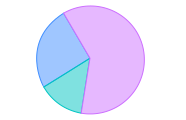
If you have a lot of slices, pie charts can be difficult to read. Other charts that show proportional values include Bar charts and Boxplot charts.
For example, you want to see a breakdown of the percentage of commission during a sales period. You can use the pie chart to visually depict the breakdown.
Configuration
Use the following configuration options to configure the Pie chart.
Note
The Configuring the Pie chart gives configuration options through the Pipe module. If you have already created charts, you can access them through your Dashboards.
Go to the Pipes module from the side navigation bar.
From the Pipes tab, click an existing pipe to open, or create a new pipe. To create a new pipe, read the Creating a pipe documentation.
In the Pipe builder, add a data source to your pipe. For more information on adding a data source, see the Data Input tool.
Add tools to build out your pipe. For more information about adding tools to your pipe, see the Using the Pipe builder canvas documentation.
Create a chart from your pipe by clicking Charts on the canvas toolbar.
Click Create Chart.
The chart page opens.
From the configuration pane, go to the Setup tab, and select the tool that you want to create a chart for.
Note
Whatever tool you select in your pipe when you add the chart is selected by default.
Under Chart type, start typing Pie to filter the list, then click the Pie graphic to select it.
Under Label, select a text or numeric column to use for the label in the pie chart.
Under Value, select a numeric column to use for the values.
Expand the Advanced field, click Show to select either Preview or Last built:
Preview displays the first 100 rows of your data from your last build.
Last build displays the first 1000 rows of your entire dataset from your last build.
Under Sort, select to sort your chart data by None, Ascending or Descending.
Click Aggregate? to aggregate your chart data.
Click the Customize tab to add custom styling to your chart.
Under Chart and axis titles, select the following to add titles to your charts. To update the title from "Untitled" to something meaningful, click on the title to edit.
Include the chart title
Include chart subtitle
Include the horizontal axis title
Under Horizontal axis label angle, select the degree from the drop-down list of angles for the horizontal axis label. This option is useful if you have longer labels, as angling the text can free up more space in your chart.
Click the Include vertical axis title checkbox to add the vertical axis title.
Under Vertical axis label angle, select the degree from the drop-down list of angles for the vertical axis label.
Under Left margin, enter the padding for the left margin or click the arrows to increase or decrease the number.
Under Right margin, enter the padding for the right margin or click the arrows to increase or decrease the number.
Under Top margin, enter the padding for the left margin or click the arrows to increase or decrease the number.
Under Bottom margin, enter the padding for the left margin or click the arrows to increase or decrease the number.
Under Colour, expand the colour field, click on the column colour, and select a new colour.
Under Legend, select the Include legend checkbox to add a legend to your chart.
Click Return to pipe to go back to your pipe. To view your chart or create a dashboard for your charts, read the Dashboards documentation.